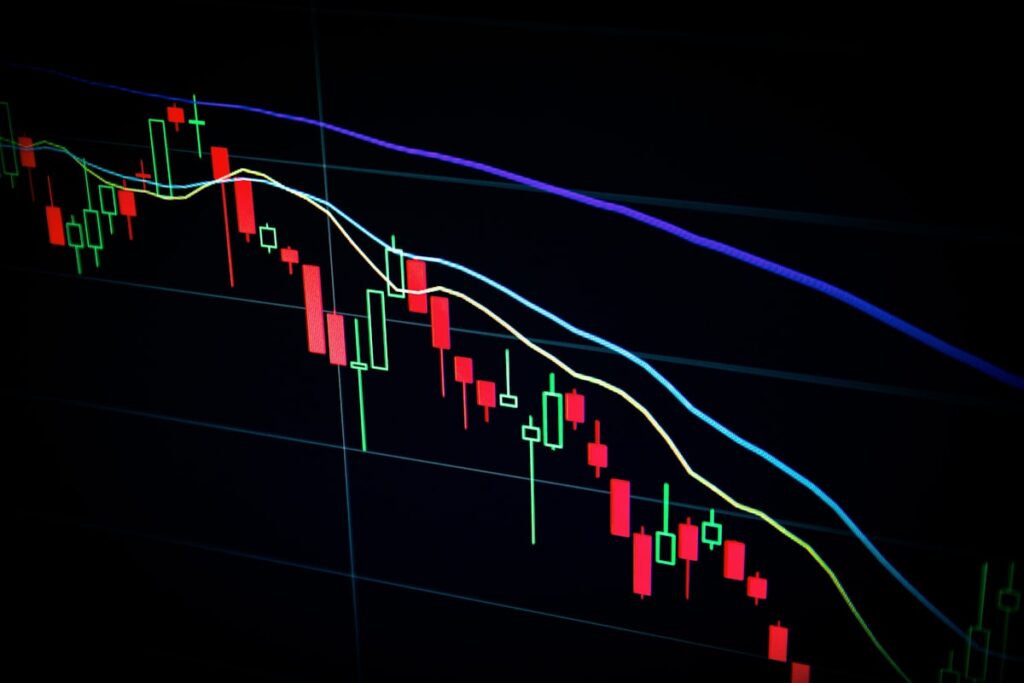
Your portfolio is down 18% and every time you open your brokerage app, your stomach drops a little. You have not touched the money — but you have definitely thought about moving it somewhere safe, or at the very least, stopping your automatic contributions until things “settle down.” That instinct feels protective. It is also one of the most expensive financial decisions most people ever make.
In this article, you will learn exactly what happens to investors who stop contributing during downturns versus those who stay the course, how dollar-cost averaging actually works in your favor when prices fall, and a simple framework for deciding whether your situation is genuinely an exception — or whether staying invested is the right call for you too.
📋 Table of Contents
- Why Stopping Contributions Hurts More Than the Drop Itself
- How Dollar-Cost Averaging Flips the Script on Down Markets
- The Brutal Math of Missing the Market’s Best Days
- When Pausing Investments Actually Makes Sense
- What History Says About Market Recoveries
- Practical Steps to Stay Invested Without Losing Sleep
Why Stopping Contributions Hurts More Than the Drop Itself
When the market falls, most people imagine that pausing contributions protects them. What they are actually doing is locking in the psychological pain without capturing the financial upside that comes after. You do not lose money by staying invested in a diversified portfolio during a downturn — you only lose money if you sell. And yet stopping contributions has the same economic effect as selling your future shares at a discount and never buying them back.
Think of it this way: every paycheck contribution you skip is a purchase you chose not to make at a sale price. If a store you love had a 20% off event, you would not stop shopping there. But that is exactly what happens when investors pull back during a correction. The behavioral economics research is clear — loss aversion causes people to feel losses roughly twice as intensely as equivalent gains, which means our instincts are structurally wired to make the wrong call during downturns.
How Dollar-Cost Averaging Flips the Script on Down Markets
Dollar-cost averaging (DCA) means investing a fixed amount on a regular schedule regardless of what the market is doing. When prices are high, your fixed contribution buys fewer shares. When prices are low, it buys more. A falling market is not a threat to a DCA strategy — it is the mechanism that makes DCA work.
Here is a concrete example. Suppose you invest $400 per month into an index fund. In January the share price is $100, so you buy 4 shares. In February the market drops and the price falls to $80 — your $400 now buys 5 shares. In March it recovers to $95, and you buy 4.2 shares. When the price climbs back to $100, your average cost per share is lower than $100, which means you are already in profit even before a full recovery. Stopping contributions in February meant you missed the cheapest shares of the entire cycle.
| Month | Share Price | Contribution | Shares Bought | Total Shares Held |
|---|---|---|---|---|
| January | $100.00 | $400 | 4.00 | 4.00 |
| February (downturn) | $80.00 | $400 | 5.00 | 9.00 |
| March (partial recovery) | $95.00 | $400 | 4.21 | 13.21 |
| April (full recovery) | $100.00 | $400 | 4.00 | 17.21 |
| Portfolio value at $100 | — | $1,600 invested | — | $1,721 (+7.6%) |
The Brutal Math of Missing the Market’s Best Days
This is where the numbers get uncomfortable. According to investor guidance from the SEC, trying to time the market consistently is something even professional fund managers fail to do reliably. The reason the math is so unforgiving is that the market’s best days tend to cluster right around its worst days.
A widely cited J.P. Morgan analysis found that if you missed just the 10 best trading days in the S&P 500 over a 20-year period, your total return was cut nearly in half. Miss the best 20 days and you barely break even over two decades of investing. Those best days often arrive without warning in the middle of — or immediately after — a period that felt too scary to stay invested through.
The Federal Reserve’s own research on household wealth, available through the Federal Reserve’s Distributional Financial Accounts, consistently shows that households who maintain equity exposure through full market cycles accumulate significantly more wealth than those who rotate in and out. The data is not subtle.
When Pausing Investments Actually Makes Sense
Here is the honest answer: there are real situations where pausing or reducing contributions is the right call, and conflating “stay invested” with “invest no matter what” is bad advice. The question to ask is not whether the market is down — it is whether your financial foundation is stable.
Pausing contributions makes genuine sense if you do not have an emergency fund covering three to six months of expenses. If the market drops and you simultaneously face a job loss or major repair bill, being forced to sell investments at a low is far more damaging than having paused contributions earlier. The same logic applies if you are carrying high-interest debt — credit card balances at 22% APR are a guaranteed negative return that no market recovery can reliably offset.
It also makes sense if the money you are investing has a short time horizon. Money you will need within two to three years should not be in equities regardless of market conditions. If you are saving for a house down payment or a tuition bill due in 18 months, a market downturn is a legitimate signal to move that specific money somewhere stable — not because of the market, but because of your timeline.
What History Says About Market Recoveries
Every major market downturn in U.S. history has eventually been followed by a recovery that surpassed the prior high — including the Great Depression, the dot-com crash, the 2008 financial crisis, and the COVID collapse of 2020. The 2020 crash saw the S&P 500 fall 34% in 33 days. It fully recovered within five months. Investors who paused contributions in March 2020 missed one of the fastest and most powerful recoveries in market history.
The U.S. Department of Labor’s guidance on retirement savings, published through the Employee Benefits Security Administration, emphasizes consistent long-term contributions as the single most reliable path to retirement readiness — precisely because it removes the emotional variable from the equation. Time in the market, not timing the market, is the consistent theme across decades of retirement research.
None of this means any individual company or sector will recover. It means that broadly diversified, low-cost index funds tracking the total market have an extraordinary track record of rewarding patience. Diversification is not just about reducing risk on the way down — it is about being positioned to capture the full recovery on the way back up.
Practical Steps to Stay Invested Without Losing Sleep
Knowing the data is one thing. Actually feeling calm enough to keep contributing when your balance is dropping is another. Here are concrete steps that help close that gap.
Automate your contributions and then stop looking. Set up automatic transfers to your 401(k) or IRA and deliberately reduce how often you check your balance during downturns. The more frequently you monitor a declining portfolio, the more likely you are to make an emotional decision. Weekly or even monthly check-ins are more than sufficient for a long-term investor.
Reframe what a down market means in your account. When prices drop, write down — literally, on paper — how many more shares your next contribution will buy compared to last month. Shifting the mental frame from “my portfolio shrank” to “I am buying more units at a lower price” is not just positive thinking. It is the accurate description of what is actually happening in your account.
Check your asset allocation, not the market level. If a downturn has you anxious, the right question is whether your allocation — the mix of stocks, bonds, and other assets — still matches your timeline and risk tolerance. If it does, nothing needs to change. If the volatility is genuinely keeping you up at night, a small rebalance toward a more conservative split is a measured response. Stopping all contributions is not.
Use the downturn as a budgeting audit. Market anxiety is a good prompt to review your overall financial picture. Are you contributing enough to get your full employer match? Is your emergency fund fully funded? Is there high-interest debt that should be prioritized? Answering those questions is a productive response to market stress. Panic-selling or freezing contributions is not.
The Bottom Line
The counterintuitive answer to whether you should keep investing when the market is down is almost always yes — with the important caveat that your financial foundation needs to be solid first. If you have an emergency fund, manageable debt, and money you will not need for years, a market downturn is one of the best environments to be a consistent investor. The fear that makes it feel wrong is the same fear that causes most people to underperform the very funds they are invested in.
Markets price in uncertainty. They recover. They reward the patient. Your job is not to predict the bottom — it is to still be in the game when the recovery comes. Keep the contributions going, keep the automation running, and let time do the work that emotion cannot.
Get the Free PaycheckGuide Budget Tracker →
Related: How to Build a 3-Month Emergency Fund on Any Income